

Inspired by Raymond Williams’s lengthy interviews with New Left Review, collected in Politics and Letters (1979), we are delighted to launch a new interview series, published on the Raymond Williams Society blog. In these interviews, we invite guests, including members of the Society and contributors to the Society’s journal Key Words: A Journal of Cultural Materialism, to reflect on their engagement with Williams’s work and the legacy of cultural materialism today. Interviews also offer guests the opportunity to promote their research, and to clarify and expand upon aspects of their work that may interest members of the Society, or which are especially prescient today.
In this first instalment, Hayley G. Toth (Secretary of the Raymond Williams Society) interviews Kate Spowage (Executive Committee member of the Raymond Williams Society and Reviews Editor of Key Words: A Journal of Cultural Materialism).
Hayley G. Toth
So, Kate, can you start by introducing yourself, and telling us about your involvement with the Raymond Williams Society?
Kate Spowage
Thanks for having me, Hayley. I’m a lecturer in English language at the University of Leeds. I work on the politics of language, writing and teaching about language policy and politics, postcolonial and decolonial linguistics, and, more recently, video games. I’ve been on the RWS Executive Committee since 2021, when I took over from Liane Tanguay as Reviews Editor for the Society’s journal, Key Words: A Journal of Cultural Materialism.
HT
Were you already a reader of Williams’s work? Or was joining the Executive Committee of the Raymond Williams Society part of how you were introduced to Williams?
KS
It was a special issue of Key Words that introduced me to Williams’s ideas and legacy. In 2016, the RWS published an issue on ‘Language and Socialism,’ edited by my PhD supervisor Tony Crowley and featuring brilliant essays by Debbie Cameron, Marnie Holborow, Jean-Jacques Lecercle and Peter Ives. That issue is still important to me – it’s a rare collection of serious socialist thinking about language. When it came out in 2016, I was at the very beginning of my PhD, and already frustrated with a dominant position in African language policy debates that often rooted itself in capitalist ideas. Lots of us seemed to be struggling with neoliberal models of language education and their aims, but finding it difficult to escape an understanding of wealth and social relations that centred GDP growth and hung its hopes for the poor on trickle-down economics. I suppose that particular issue of Key Words gave me a very different way of thinking about language problems, particularly through Peter Ives’s essay on global capitalism and global English.
In my PhD, I was looking at Rwandan language policy, partially to understand whose interests it served, and whose interests it failed to serve. And partially I was trying to understand how English has acquired the status of a ‘global language’, because I was dissatisfied with what I would now call, following Selma Sonntag (2009), a cosmopolitan model of English. Since the term ‘global English’ was popularised in the 1990s, the dominant explanation for the rise of English has been cosmopolitan, especially in commonsense discourse. Basically, it holds that English has become a global language because the world’s citizens have chosen to learn it and to speak it. And those decisions are understood to be made freely, by global citizens who have the time, money, and inclination to learn and use English. It overlooks the fact that, globally, most people do not, and might never, speak English. It also underestimates the significance of political power in supporting global English.
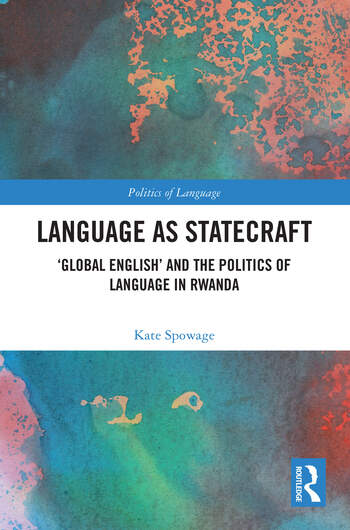
So my introduction to Williams’s work began there, and it’s since become clearer to me how woefully underexplored language is in relation to socialism and non-capitalist worldmaking. After that issue, I read Williams. I devoured fragments of Keywords: A Vocabulary of Culture and Society (1976), but I didn’t really get it for a while. I feel like it took me a couple of years to get a handle on what the whole Keywords project was about. And really, I had to teach it – and teach it for one semester with a pretty shaky understanding! – before I made sense of Keywords. But it was particularly Marxism and Literature (1977) and Problems in Materialism and Culture: Selected Essays (1980) that were really generative for my research, in terms of thinking in more nuanced ways about ideology and culture, and how we might treat them not as reflections of political and economic processes, but as forces that have agential power in their own right. The PhD project became my book, Language as Statecraft (2024), arguing that we need to take the cultural side and the material side of sociolinguistic life seriously and investigate their interrelations. We haven’t done very much of that in sociolinguistics or applied linguistics – at least not yet.
HT
You mention your book Language as Statecraft: ‘Global English’ and the Politics of Language in Rwanda (2024). One of the things you’re describing about your work is its tendency to interrogate or undercut an existing scholarly consensus or scholarly trend that takes capitalism for granted, and doesn’t deal with capitalism critically. But, in fact, one of the interesting things about Language as Statecraft is that it’s not only a critical account of capitalism and its relationship to the question of the spread of English around the world. It’s also an account that centres the role of the state. Your book opens by insisting that “the state is or should be a central concept for interrogating the politics of language.” It’s a simple claim. And we’ve talked a bit about what it means to look at capitalism critically. But I wonder: could you tell us what it means to you to foreground the state in that way, and to think about the state critically in these debates?
KS
You’re right – I’m often trying to figure out where capitalism fits into the knowledge we have. To get why I make that point about the state, you have to understand that in my broader field, we often take for granted certain ideas about human agency. There is an almost compulsive emphasis on agency in linguistics. My work essentially argued that teaching through English shored up class reproduction, and when presenting it I would be asked, like clockwork, where the space was for agency. It was as though the project I should have done would identify moments and spaces of agency for dispossessed learners – working-class students for example. And there was a sense that agency should be the crown or cornerstone of the story I was trying to tell.
It was very generative to have those conversations, and they really shaped the conclusion to the book. I don’t want to dismiss the questions, or make it sound like linguists or intellectuals should ignore agency. My position is really the opposite – we need to think about it, but critically. I struggled to answer those questions for years, because I was like “well, yes, we do have agency.” I know that. The very fact that I’m able to comment critically on capitalism is evidence that I have agency. And, if I do, everybody else does, right? But the more pressing story that emerged from my research was about the ways that agency was constrained. It was a story about structure, in that classical sense of structure as the forces that constrain agency and influence people’s actions in ways they don’t necessarily have control over. The state is crucial to understand, because it’s one of the major powers that influences the specific structures that we navigate.
Now in the debates on global English and language policy, like in other areas of formal politics, some argue that the state isn’t as influential or important as it once was. Globalisation is figured as a process that neutered the state, with corporations becoming far more powerful than the state ever was. I think that that’s a misunderstanding. I think it’s really important, whether you’re trying to analyse power or thinking about how to enact practical change, to recognise that even if it doesn’t action it, doesn’t use it, the state does have power. It could curtail the routine tax evasion of mutinational corporations. It does legislate language in different ways that serve specific social interests, including its own. The state also retains the monopoly on legitimate violence and punishment. But its actions are not totally unconstrained either – for example, the state manages and responds to struggles between domestic political factions. In contexts readers of this blog are likely to be familiar with – the US and UK – the state responds to the interests of the major parties, their donors, and lobbyists. Those complex considerations were often underexplored in conversations about language policies in Africa, which tended to focus on notions like development and globalisation. And so, it seemed to me that working with the state allowed a fuller and I think more realistic understanding of where speakers can and cannot exercise agency.
Centring the state also allowed me to think about the agendas and interests served by language policies that we have tended to think about as failing speakers. The discourse in applied linguistics can tend towards a style of analysis where we talk about language policies that are broken or failing. We might even take policies as evidence that planners don’t realise that teaching through English is detrimental to students who have no access to the language at home or through private tuition. And that’s too charitable, I think. We have to bring the state into the picture and analyse it, partially from the perspective of political history. We need to ask, actually, who controls the state? How do they gain control of it? Who do they struggle with for control? These questions bring up different answers to the language policy question – suddenly it doesn’t look like teaching through English is some kind of broken policy or failure of the state, it looks like it’s doing precisely the job of sorting the population. EMI policies ensure that most people do not get a full education, so they have to go into the kind of raw material extraction that is important in Rwanda and many other African countries, while the few who do access education are distinguished (in Bourdieu’s 1977 sense), and include the people who become part of the state machinery.
HT
And what would you say to those who might say that sounds like a particularly prescriptive view of the state, wherein the state has the power to prescribe and proscribe, and performs this kind of linguistic management deliberately? I suppose I’m thinking, based on your discussion of capitalism, about how the state has other interests – like capitalism, for instance – and about how linguistic management and the politics of English can to some extent be a byproduct or an effect of, say, trying to make super-exploitation work. From that perspective, making Kinyarwanda speakers struggle to learn English is not necessarily the state’s goal, but more of a necessary process through which it guarantees that the majority of Rwandans go into menial and manual work, or subsistence farming. As a kind of counterpoint to a vision of the state as a deliberate actor, I imagine there will also be people out there, not least in Britain, who would say the state doesn’t know what it’s doing half the time, let alone is this kind of wilful and deliberate actor that always knows exactly the objects of its attention and the implications of its policymaking.
KS
That question of ‘deliberateness’ is a really slippery one. I am actually quite careful in the book not to make too many assumptions about what is deliberate and what is not. ‘Trial and error’ is, to me, the best model for understanding why language policies that mandate formerly imperial languages are so prevalent globally. And they really are – most postcolonial countries require that state-supported education be taught through English, French, Spanish, or Portuguese. It begins with the radical break of colonisation. Colonisers needed translators and functionaries to enable them to intervene in the lives of the people. Local people were educated in imperial languages, and performed duties that were essential to the colonial state, including overseeing workers who didn’t speak imperial languages. In several ways these educated people, who were at least bilingual, helped to justify the colonial regime. In Rwanda, for example, the Belgian administration worked hard to gain the support of the monarchy and the aristocracy, which were its primary antagonists in the 1910s and early 1920s. They incorporated both groups by founding the education system and offering French and state jobs to those who enrolled. Then this kind of symbiotic hegemony emerged, which served Belgian and élite interests, and the two collaborated in the new system. Obviously, Belgium dominated, as did Whiteness, and this hegemony was strained by tensions that would ultimately feed into the liberationist politics of the 1950s. But when a language is taught to a very small number of people in this way, and a capitalist society allocates certain kinds of work to Francophones, one of the consequences is that people are simultaneously shut out from the language and from work opportunities for the formally educated. In Rwanda, the excluded became coffee farmers more than anything else. Trial and error produced benefits for the political class – Presidents Kayibanda and Habyarimana, particularly, profited from the coffee economy and secured power on the back of its success.
There’s also a wider ideological importance to the whole dynamic. English or French or another colonial language becomes seen as a language of the learned, a language of intellect, a language of the dominant class. The élite status of these colonial languages in turn creates the conditions for very pervasive myths that these are languages that are superior because of some internal quality. These myths are promoted by colonisers, but also linguists and others who write and philosophise about language throughout the colonial project. So if any of these discursive or governmental practices become deliberate, I think they become deliberate because they turn out to benefit the state and the reproduction of capitalism. They reproduce the social formations that these states require by stratifying workers in sociolinguistic terms – by building a kind of sociolinguistic structure that also, of course, reflects class-bound sociolinguistic structures that already prevailed across Europe.
HT
You conclude the book by telling the story of Ngũgĩ wa Thiong’o’s 1976 collaboration with Ngũgĩ wa Mirii and the Kamiriithu Community Education and Cultural Centre to produce a play that both of us know quite well, Ngaahika Ndeenda (I Will Marry When I Want), first performed in 1977. It was this play that reportedly led to Ngũgĩ’s arrest and detention without trial in December 1977. Nonetheless, the decision to write the play in Gikũyũ, you suggest, alongside the play’s thematic concern with organised resistance, offers what you call a “working vision of resistance”. You write:
Kamĩrĩĩthũ does not give us an answer, or a blueprint for resistance. Rather, it offers one working vision of resistance that is empowered by decisions around language use, counters established patterns of language use, and takes aim at the structures that generate class-based exploitation, with sociolinguistic implications. It shared some features with projects that aim to foster local language literacy and cultural production, which are undoubtedly important in their own right. But it was also overtly politicised and critical, and as such the use of Gĩkũyũ became critical to the creation of a more organised form of resistance. The plays themselves critique the status quo upheld by the Kenyatta government. The praxis behind the production led to connections between participants from different social groups, who together developed an analysis of the problems facing Kenyan people. It led to the elaboration of alternatives in theatrical and linguistic practice, both of which were bound up with issues of social power. As such, it could be seen as part of the creation of a new historic bloc, in opposition to Kenyan neo-colonialism (as Ngũgĩ sees it) and the social dynamics it preserves, including the suppression of art and collaboration in local languages (see Ngũgĩ 1981; 1986; 1998). There was a clear ideological function to the work, in the sense that it had the potential to change minds on matters of linguistic and political practice. (Spowage 2024, 176–77)
I found this a really perceptive account of the play, but also a quite surprising one in the context of the book, which is so concerned with materialising language or with recontextualising language by way of material life and interests. Language as Statecraft, as we’ve discussed, links something (language) that has been presumed to be cultural – and even individual – back with political economy. In that way, it interested me that the book turns in the conclusion to cultural resistance – to cultural production as a site of resistance. I wonder if you could elaborate on how you see the role of culture in relation to political change or language policy specifically?
KS
Ngũgĩ’s project at Kamĩrĩĩthũ is really quite special and probably understudied, certainly in applied linguistics and sociolinguistics. I ended up closing the book with it because I re-read Decolonising the Mind: the Politics of Language in African Literature (1986) while I was finishing my book. I realised something I hadn’t before: that the whole of Decolonising the Mind really turns on the chapter about Kamĩrĩĩthũ and the language of African theatre. Ngũgĩ’s argument, in brief, is that literature produced in colonial languages can’t be accessed by the African working classes and peasants (to use his terms and categories). So Europhone literature can’t be the foundation of a national literature or imaginary, which is one of the issues Ngũgĩ explores. Attempts to build a national culture are frustrated by European languages, but they’re also frustrated by written language because in a lot of African societies the literacy required to read a novel, say, is not universal, and it patterns with factors like gender, urbanity, and especially class. Theatre in local languages is much more accessible – it’s not exclusionary from the outset.
So after being sort of cajoled by this woman who knocks on his door every weekend, Ngũgĩ basically gives in to her request and starts working with a group of people at the Kamĩrĩĩthũ Cultural Centre. He’s at pains to talk about their different class positions – some are unemployed, others are manual labourers, teachers, or businessmen, and they’re all working together. It’s a cross-class collaboration. And there’s something really important, I think, in the fact that this process brings together people from different classes who are usually very remote from each other. The usual business of capitalism is to atomise them, right? It’s to spatially and socially separate them. It’s to put them in different neighbourhoods with different levels of wealth, different kinds of housing and infrastructures. But it’s also, in a society like Rwanda, or like Kenya, to linguistically separate them: to endow one class, broadly speaking, with an imperial language, and to allow knowledge of that language to diminish as you move down the class ladder. So Ngũgĩ talks about Gikũyu as a medium that connects these different classes in the practice of collaborative production. It’s as a result of those two things, I think – the cross-class collaboration and the use of Gikũyũ that enables it – that they arrive at an analysis of Kenyan neo-colonialism (Ngũgĩ’s term), which includes Kenyan capitalism, and ultimately produce a play that is very critical of these political economic forms.
The reason that Kamĩrĩĩthũ really speaks to me is partially because of the shared language aspect of the project. But, for me, it’s really about what that enables, and the fact that, when those class barriers are kind of displaced for the process of producing the play, it produces an allied middle class, working class and peasant class that are all identifying the same problems with Kenyan society, i.e. the fundamental structural problems of capitalism.
The content of Ngahika Ndeenda is performed in Gikũyũ, and also uses dance and song and other cultural forms that are relevant and recognisable to the play’s audiences. Because of all of that, it’s able to become something that is not just superficially ‘of the people,’ but also aiming to be artistically and politically ‘of the people’ in challenging things that marginalise them. So that’s really what I think the power of the Kamĩrĩĩthũ is. As Williams would have it, the play demonstrates the power of culture to shape the material. Culture is one very accessible area where resistance might begin, because anybody who has the time can get together and produce a play of that kind. And that’s really what is shown by the Kamĩrĩĩthũ experiment.
HT
I think you know how I feel about Kamĩrĩĩthũ. And the account presented in the book is exciting and offers a different take on Ngũgĩ wa Thiong’o and Ngũgĩ wa Mirii’s project with Kamĩrĩĩthũ Community Education and Cultural Centre. Its political power lies precisely in how its production process is a kind of concrete refraction of material concerns. This is a collaborative play, but it’s also, like you say, a cross-class collaboration. It’s not just about the thematisation of what’s going on in Kenya, but how it’s produced. It’s about process. I could ask you more about this, but, thinking about the role of culture, I want to move on to talk about your recent work on other cultural media, including video games. In 2025, you published an article with Language in Society about Civilization, a popular series of turn-based strategy games in which players attempt to explore, conquer and colonise territory. You’re also in the late stages of co-editing a special collection for the Open Library of Humanities Journal focused on The Last of Us, which readers might be aware is a post-apocalyptic action-adventure game, since adapted by HBO for television. Why do you think video games in particular merit critical attention? What do they reveal about the politics of language?
KS
I think the first thing to say about video games is that they’re big business. That is what really drew me to them in the first place. Grand Theft Auto 5 was the highest-grossing media product of all time. We still have this sense that video games are trivial, but they are culturally and materially important parts of late capitalist production and ideology.
Players have collectively spent one billion hours on Civilization V – that’s an incredible amount of time. The average Civilization VI player, as I say in the article, has spent 366 hours on the game. If you think about traditional objects of ideology critique – films or novels, for instance – people just don’t spend the same amount of time with them. We can and should talk about Marvel films as ideology, for example. But, even if you watch them all twice, it would take less than 150 hours – and it’s not interactive in the same way as a game. Video games are hugely important in ideological terms, because of how popular they are. I have no stakes in the distinction between high culture and low culture, but I think that the perception of video games as low culture is one of the reasons that they haven’t been paid as much attention to as they deserve.
So when I started writing about Civilization, I was ready to write a piece that was about a game that tends to reproduce Eurocentric narratives, and colonialist narratives, and is riddled with these sorts of problems. This is how Civilization has tended to be treated in postcolonial studies. What I ended up writing was in fact very different, and was inspired by your work, Hayley, on reading and reception. What I found was that if you look at how people play the game, you see something that is a lot more like Kamĩrĩĩthũ. Process becomes really important. Civilization does, as I outline in the piece, embed various unhelpful fictions about language, including the idea that colonialism had no impact on language matters – meaning that there is no sociolinguistic question of colonialism. However, in their fan communities, players of Civilization essentially talk about linguistic issues, even some that sociolinguists rarely consider, like toponymy – placenames. They speculate on the reasons that colonial powers might rename places, as indeed many of them did, and draw out the political significance and importance of toponymic changes. So for me, looking at video games has become about seeing where people might be nurturing criticality and sociolinguistic or political awareness, using popular media. I also think video games and their popular audiences could potentially provide leads for thinking about areas of sociolinguistic life which are undertheorised or not fully understood, but which belong at the heart of a sociolinguistic or applied linguistic project, such as power, colonialism, and the politics of language.
HT
In the article, you talk about players of Civilization as vernacular theorists of language. It was a framing I really enjoyed, in part because of my own work on non-professional readers as interesting and interested readers of postcolonial literature. What does it mean to think about gamers and other non-experts as theorists?
KS
The reason I talk about players as vernacular theorists is that I didn’t want to talk about them as people who just have opinions about language. I didn’t want to use the vocabulary of folk linguistics or language ideologies, both of which presume that there is some kind of definite reality when it comes to language, which is not being captured by people who aren’t trained as professionals. ‘Language ideology’ is the usual term for this sort of thing, but it suggests to me both a kind of non-rational belief that might be based in emotion, presumption, or prejudice, and something that is non-reflexive, that people don’t probe or rethink in line with the world they encounter. But the whole argument of vernacular theory is that all of us theorise, all of the time. We theorise when we try and make sense of the world. And our theorising, which we usually just call thinking, often rubs against the ideological structures that encourage us to think about things in ways that serve dominant interests. That was part of what was so compelling about Civilization. Many of the ideological premises that were coded into the game were rejected by vernacular theorists, or were complicated by them, or attenuated by them. Whatever players were doing, they weren’t swallowing them whole. I couldn’t find the concept of vernacular theory in use in any other sociolinguistic research, so I hope that the article opens up a different way of engaging with people’s ideas about language.
An important part of it is that, with these players, discussions about language aren’t about moving towards professionalism. They’re about doing something different that is, in some ways, parallel, or adjacent, that involves exploring and highlighting questions that have tended to be marginal in professional linguistics. For me it’s really compelling that these vernacular theories don’t derive authority or a line of questioning from the professional view of language. And it can be the case, as I show with Civ, that players have misconceptions about language, but they usually have them from very progressive places where we might quibble with the linguistic or historical detail, but their politics might be something that we agree with. I highlight and try to draw out some of those complexities, where players either get things wrong or make claims that don’t fit our models – those are two different things of course. The point of calling them vernacular theorists isn’t to edify them and say, you know, this is incredible, exceptional, like unbelievable talk that we’re overlooking. It’s not to be voyeuristic in that way. It’s instead to recognise that this is thinking in action. It has blindspots, just like scholarly work, but it offers an alternative discourse on language that is certainly worth bringing to the attention of professionals, and which may take us in different critical directions.
HT
That’s right, I think – that everyday cultural practices are critical and sophisticated, and should interest us, especially where they seem to gain perspective from exceeding or flouting the conventions and protocols of professional judgment. We could talk about this more, I’m sure, but it raises a question for me about the responsibilities of scholarship. Can we wrap up this interview by discussing how you see your role as a scholar and academic?
KS
In Politics and Letters: Interviews with New Left Review (1979), which collates all the fantastic interviews Williams did with New Left Review, Williams said something that really resonated for me. He was asked about The Country and the City (1973), and made the point that we need to think about whose side our work is on – whose interests it serves. It’s only a small comment from Williams, and he doesn’t reflect on it in any great detail or anything. But it recalls for me contributions that several scholars have made about the responsibilities that come with what we do, from Edward Said on amateurism, to Noam Chomsky on intellectual responsibility, and Antonio Gramsci on organic intellectualism.
Williams’s question is vital – whose interests does this work serve? We shouldn’t comfort ourselves that our work is outside of social struggles. The question of interests calls on us to try to do good with the work that we do. To start from a perspective that is endorsed by transnational capital, for example, might preclude us from serving the interests of the world’s most exploited people. You need to work through those tensions and figure out what they mean for you. I’ve thought a lot about how to deal responsibly with the questions that impact the lives of the global poor and, more recently, the practices of popular audiences, who are easily imagined as duped by capitalism or exoticist. Obviously, these problems are at very different scales. But they beg the same questions, really: if your work were to change the world, even in a small way, who would be better off for it?
_____________________________________________
Language as Statecraft: ‘Global English’ and the Politics of Language in Rwanda is reviewed in Key Words 23, out Autumn/Winter 2026.


